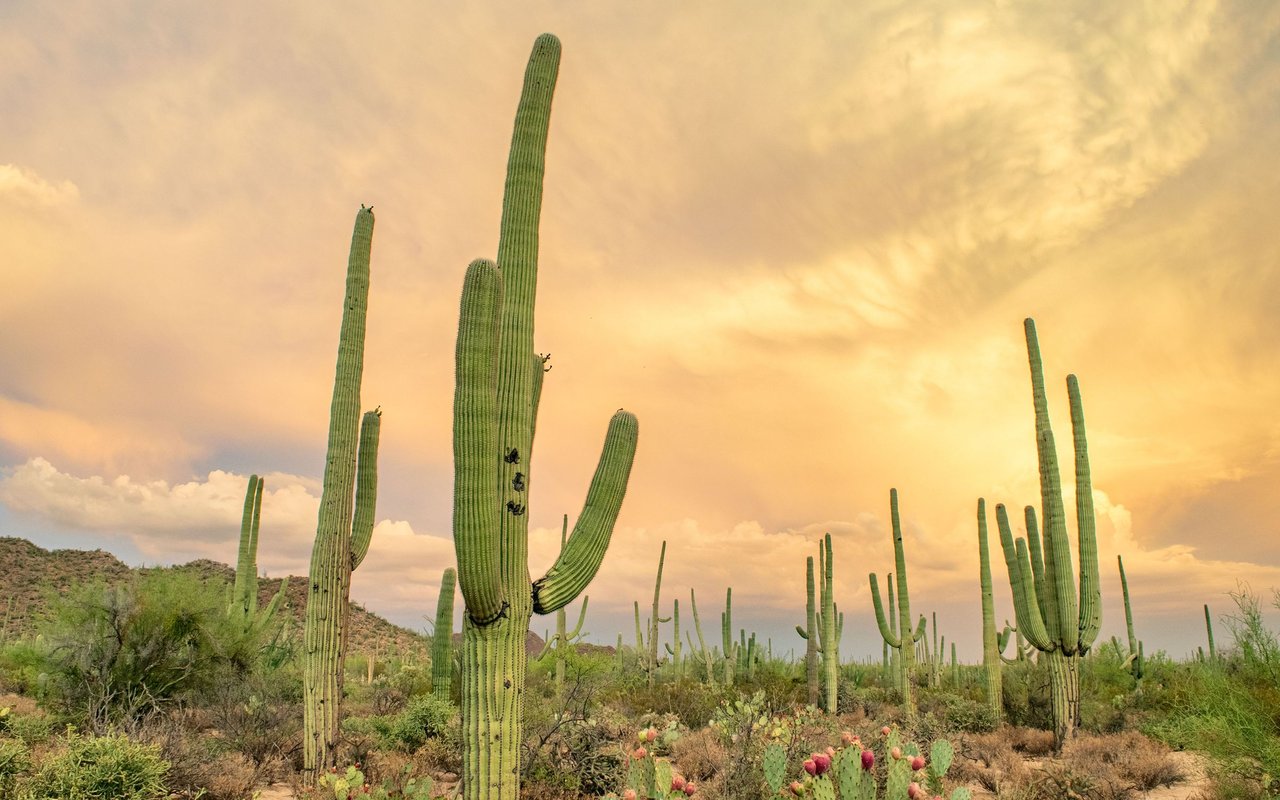
At a federal land auction in 1928, John Murphey bought a 7,000-acre tract north of River Road between Oracle Road and Sabino Canyon. The stock market crashed the next year. According to the Catalina Foothills Association's history of the area, Murphey then tried to sell some of the land to an Arizona banker for $10 an acre, and the banker turned him down because he considered the land "worthless."
Murphey and his wife Helen had planned ten subdivisions on lots of more than three acres each, laid out for privacy, desert vegetation and views. In the early 1930s they began working with the Swiss-born architect Josias Joesler. Construction started on Catalina Foothills Estates in 1935, just northeast of Campbell Avenue and River Road, and St. Philip's in the Foothills followed in 1936 at what were then two dirt roads. Farther up the hills, a home built in 2024 inside the gated community of The Canyons, northeast of Campbell and Skyline Drive, sold earlier this year for $8.6 million. The Arizona Daily Star reported that the sale set a Tucson-area record.
The Foothills now includes both Joesler's 1930s Southwestern designs and a five-acre estate finished in 2024. That range matters a lot when you read the Foothills market. A buyer shopping here this winter will learn more from two other numbers than from the median price on the portals. One is price per square foot. The other is how far below asking homes are closing.
Why the Foothills median swung $100,000 in two months
The MLS of Southern Arizona reports monthly figures by MLS area. Its North area covers the Catalina Foothills on the official area map, though the map draws boundaries rather than naming communities. Here is that area from July through October 2026, taken from the Tucson Association of REALTORS monthly reports:
| Month, 2026 | Sales | Median sale price | Price per sq. ft. | Median days on market | Avg. sale vs. asking |
|---|---|---|---|---|---|
| July | 114 | $590,000 | $280 | 33 | 2.8% under |
| August | 86 | $640,000 | $297 | 25 | 2.5% under |
| September | 67 | $551,000 | $291 | 40 | 2.6% under |
| October | 80 | $540,000 | $283 | 28 | 3.5% under |
Between August and October the median fell $100,000, about 16%. Over the same two months, price per square foot went from $297 to $283, a drop of under 5%. If the same kind of house were simply selling for less, both numbers would fall by similar amounts. They didn't, which suggests that much of the drop in the median reflects which homes happened to close each month, not a matching drop in what each square foot was worth.
That kind of swing is easy to get in the Foothills because the sample is small and the homes vary so much. With 67 to 114 sales a month, a few large closings can push the median up, and a month with fewer of them can pull it down. The year-over-year comparison has the same issue. The North area's October median was $50,000 below October 2025, while price per square foot was $14 lower. That's a softer decline than the median suggests, and it's a better starting point when you're deciding what a particular house should cost.
The figure that held steady: the gap below asking
The figure that stayed consistent through the fall is the gap between asking price and sale price. In every month from July to October, Foothills homes closed on average 2.5% to 3.5% below asking. In October the gap widened to 3.5%, compared with 3.2% in October 2025.
Compared with the rest of Tucson, that gap is wide. In October 2026, the North area's 3.5% was wider than any of the city's other main MLS areas. Homes in the Northwest closed 1.8% below asking, Central 2.3%, East 1.6%, Northeast 2.1% and Upper Northwest 2.4%. Across the whole MLS market, the October average was 2.03% below asking.
Speed is the other half of the picture. The North area's median time on market in October was 28 days, faster than the 36-day median for the whole market. So Foothills homes sell quickly, but they close further below asking than elsewhere. A wide gap paired with fast sales usually means asking prices start a little above where buyers end up. Buyers are still active, and they negotiate down to a price they accept.
To put the gap in dollars, 3.5% of the October median of $540,000 is about $19,000. That's simple arithmetic on an average, not a promised discount on any particular house. Some homes sell at full price, and some close well below. Still, it tells a Foothills buyer what a typical negotiation looked like this fall.
One likely reason asking prices start high is that the top of the Foothills market keeps setting records. In addition to the $8.6 million sale in The Canyons, the Arizona Daily Star reported this fall on two listings bordering Sabino Canyon. One is the 73-acre Querencia Estate on North Rattlesnake Canyon Road, designed by Tucson architect Ron Robinette and listed at $10 million. The other is a 10,431-square-foot home on North Canyon Ranch Drive listed at $9.8 million. The Star described local luxury sales, typically to out-of-state second-home buyers, as strong and record-breaking over the past five years. Those homes sell to a different set of buyers than a $540,000 house off Campbell does, but they shape the impression that the Foothills is a high-priced market. The gap below asking suggests that buyers at the middle of the market are not paying record-era prices.
How the Foothills compares with nearby areas
Buyers comparing the Foothills with other north and east side areas are mostly deciding what a square foot is worth to them. In October 2026, the North area's price per square foot was $283. The Northwest area was at $252, Upper Northwest $245, Northeast $248 and East $202. Across all single-family homes in the MLS that month, it was $226. That makes the Foothills about 12% more per square foot than the Northwest and about 40% more than the East side.
The negotiating room partly offsets that premium. The Northwest closed only 1.8% under asking in October, with a 27-day median on market. Homes there sold about as fast as Foothills homes but with roughly half the gap. A buyer who compares asking prices between the two areas without accounting for that difference will overestimate how much more the Foothills costs.
The wider Tucson market is also giving buyers more room this fall than last. The whole MLS market had 5,193 active listings and 5.70 months of supply in October 2026, up from 4.71 months in October 2025, while closed sales fell from 1,075 to 911. The MLS reports supply for the whole market, not by area. Even so, more homes on the market across the city fits with Foothills buyers getting more room to negotiate. For broader context, our October 2026 Tucson market update covers the citywide trends.
Carrying the fall numbers into a winter search
The July through October figures point to three practical habits for a Foothills search this winter.
First, judge a listing by its price per square foot against recent nearby sales, and use the area median only as a rough guide. On these hills a monthly median depends heavily on whether a few estates closed that month, and no single house sits at it.
Second, expect to negotiate. A 3.5% average gap in October and 2.5% or more in every month since July means a Foothills offer below asking is common, not an insult to the seller. How far below depends on the house, how long it has been listed and what similar homes closed for.
Third, be more careful at the top of the price range. Across the whole MLS market, homes that sold for $1.4 million or more in October 2026 had a median of 97 days on market, compared with 25 days a year earlier. Very few homes sell at that level in any month, so one long listing can move the figure. The record sales in the Star don't mean every high-end Foothills home sells fast.
Questions buyers ask about these numbers
Is the MLS "North" area the same as the Catalina Foothills? They largely overlap. The MLS of Southern Arizona draws its areas as polygons on a map and does not label them with community names. The North area covers the Foothills north of central Tucson, and Northeast and Upper Northwest are separate areas next to it. Treat the North figures as a close match for the Foothills, not an exact one.
Are Foothills home prices falling? Per square foot, they softened a little this fall. The North area went from $297 in August to $283 in October, and October was $14 below a year earlier. The bigger swing in the median likely reflects which homes sold each month.
Where can I read the MLS reports myself? The Tucson Association of REALTORS posts monthly MLSSAZ reports on its market statistics page. The October 2026 report includes the region table used throughout this post.
If you're weighing a Foothills house against one in the Northwest or on the East side, The Elena Team can pull the price per square foot and sale-versus-asking numbers for the homes you're actually considering. We'll tell you plainly whether an asking price leaves room to negotiate or whether the house is worth paying full price for. You can start with our Catalina Foothills neighborhood page, then reach out in English, Spanish or Vietnamese. Contact us.